
Beyond the Suite Webinar – Simplify Accounting Workflows
The "Beyond the Suite Webinar" hosted by Silverfin addresses frustrations with legacy accounting systems like CCH, IRIS, and Caseware by exploring how adopting best-of-breed, cloud-based solutions can simplify workflows, reduce costs, and improve ROI, featuring insights from industry experts and real firm transitions.
Frustrated with the limitations of legacy systems like CCH, IRIS, or Caseware, but unsure about making a change? You’re not alone. This session tackles common concerns around standardisation, cost, and complexity, showing how a best-of-breed approach can simplify your workflow. Discover the ROI of switching to a cloud-based solution like Silverfin and hear how firms like yours have successfully made the transition.
Press O for more options
Click for sound
49:19
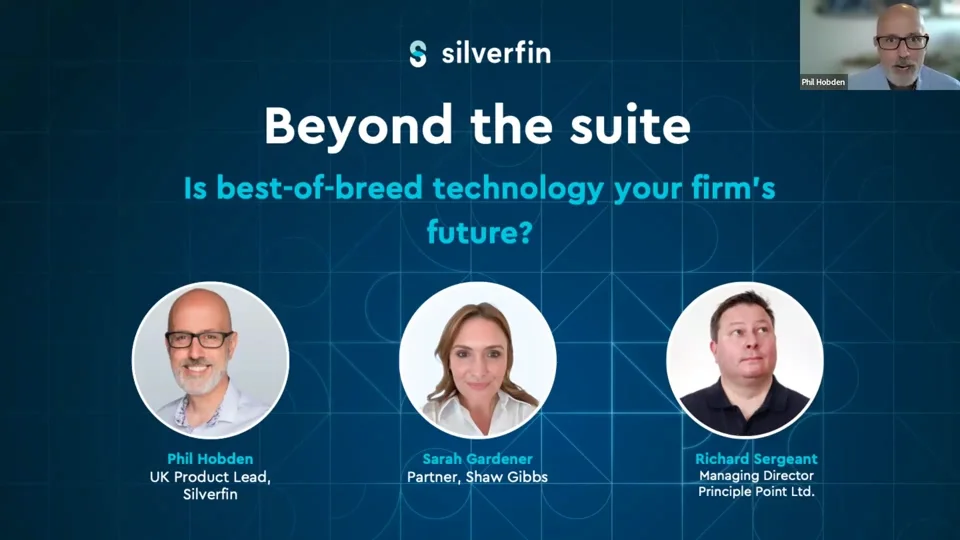
Well, good morning, everyone. We are, thank you for joining us on this sunny Wednesday morning. My name is Phil Hobden. I’m the UK product lead here at Silverfin. We’re gonna be chatting to you a little bit about Beyond the Suite, Is best of breed technology your firm’s future? We’ll give you, we’ll give people a few minutes to dial in because I appreciate that, you know, it is just gone the hour, and normally people are rushing off to get that cup of coffee and do everything else that they’re going to do first thing in the morning. I’m joined by, two fantastic guests this morning, and I will introduce them to you in a second. But we’ll give give people another minute or so just to dial in. Meanwhile, while you’re doing that, feel free. I think the chat’s unlocked. I think you should be at a kinda chat in the chat, but, feel free to drop a chat over to just let me know where you are in the UK and, you know, are you having, you know, what degree of thirty degrees are you closest to at the moment? Because certainly, down here in the Sussex where I am, it’s baking, and I’ve put my webinar shirt on especially for this call, which means I’m super hot. I mean, I’ll be honest and say I am still wearing shorts though. So I’m doing that that classic. Like, I call it the COVID move where people were, like, smart up top and and casual down the bottom. So, look. I think we’re we’ll get started. I’m sure a few more people would join us as we get going. So, welcome to the Silverfin webinar Beyond the Suite: Is best of breed technology your firm’s future? As I said at the top of the the call, my name is Phil Hobden. I’m the UK Product Lead here at Silverfin, and I’ve been working with accountants, and technology for about the last ten years to help them implement technology, launch service lines, and kind of transform some of the key functionality that they do in their practice. Today, I’m joined by, Sarah Gardner, who is a partner at Shaw Gibbs, and Richard Sergeant, who’s a managing director of Principle Point Limited. I will go to Sarah first to do a quick intro, and then, Richard, I’ll jump over to you. Thank you, Phil. So as he said, I’m one of the partners here at Shaw Gibbs, and I head up our Outsourcing division. And really, we have used that division as a catalyst for change across the whole organization with a key focus on the tech stack, that we’re adopting. We are a forty million pound business now, across ten offices, with around four hundred team members joining us. Marvellous. And someone that it’s fair to say I’ve worked with a couple of times in the past. So, always good to have you here on the webinar with me. And then, over to Richard. Hi, everybody. My name is Richard Sergeant. I’m the MD of Principle Point, and I run a small consultancy business that works almost exclusively with software vendors who are building products for accountants and bookkeepers. So my interest here is really not necessarily to kind of tell people what they should be doing, but to try and give a bit of kind of my perspective of what’s kind of going on in the market. Also, I’m heavily involved with accounting rev intelligence, so I need to give them credit because we might lean on some of their research and to kinda give context to some of the discussion as we go through. Perfect. And I’ve just realized that I’m actually quite on brand because the headshot photograph of me on the, on the slide is actually the same shirt I’m wearing now. So now it actually only looks like I’m wearing I have one shirt in my entire wardrobe, which is not the truth. So, brilliant. So let me set a bit of a scene. Recently, I ran a poll, asking UK accountants whether they consider their firms to be taking a best of breed approach to technology. And here’s kind of what they told us. And I guess on screen, you’re seeing the the the key headline on that. Ninety three percent of firms consider themselves to be taking a best of breed approach, and we’re gonna show a little breakdown on some of the areas around that. But what was really interesting is when you start to dig into, best of breed, it actually turns out that that whilst best of breed is certainly the intention, it’s probably not the execution. Because as you can see here, you look at e-signing software, whilst 55% of firms were were leaning towards DocuSign as their chosen provider, 28% was still embedded within their suite. If you look at internal comms tools, 30% were using Slack, 33% were still embedded in their suite. Practice management, 25% were were using Karbon, and 32% were embedded in their suite. So for sure, there’s definitely a desire to have a best of breed approach, but we’re finding that the execution maybe isn’t as simple as that. And I’m gonna give Michael Ford from, passed away a credit here because I put a post out about this this webinar, and he said, is it best of breed or is it best of need? And that really got me thinking actually. It is maybe really, you know, is this a best in need approach? So we’re gonna dig into that across the next thirty to forty minutes, and I’m gonna talk to Rich and Sarah and get some of their insights on some of the data that we found and, you know, some of the the ideas behind that. But before we do that, I wanna ask a quick poll. And this came from a conversation that we had, when we were kind of talking about the webinar. And the poll is this, would you use the same technology in your firm if given a choice today? Now, my wonderful Silverfin assistant is going to run that poll in the background. There we go. Look at that. Perfect. And now I can’t vote on this, but, we will kind of have a look in a second. So when we get to around seventy five percent of people are doing that, we will, flip the results out. Sarah, I think this this kind of, we were talking about this, and kind of asked that question. And what what would what would your answer be? You know, if you could if you’re starting up a firm today, what would your approach be to to the technology? I completely agree with that comment, best for needs. You know, reverting back to the pie charts you had on your screen a second ago, Shaw, Gibbs and our current guise would fit into the other, slice of each of those those pie charts. So I think it is very much best for need. If I were to start a firm again tomorrow, would I choose most of the technology we’re using? Absolutely. But I think Richard will come on to talk about some of the cost implications of that. I think it’s fair to say as a firm, if we could start or have one piece of, kind of full service, we would. It just does not exist currently for a business of our size, unfortunately. Excellent. Silverfin, my wonderful Silverfin assistant, I don’t know if you can, show those, results for me, from the poll. If not, maybe just copy and paste them and pop them into the chat. That’d be great. But I think what we’ll do now is we’ll we’ll probably drop the slide deck and just go over to, us to have a conversation for a period of time. So I think you kind of indicated, Sarah, and I think it’s a really good point that, you know, there are certain challenges that come with a best of breed approach. And, of course, one of them is is cost. What are the kind of other? Maybe, actually, let’s take a step back, and I’ll ask you both. Is best of need really the right way to look at adopting technology within a firm? Now, Sarah, you said I think it’s a very good point. If there was a all in one solution that did everything you needed, you would go for that. And I’m assuming there’s a cost and need, and I’m sure you can talk about that. But is is this kind of is this something that you would want to do, or is the best of breed approach actually something that we are having to do because the technological solutions aren’t out there? It’s not new for us at the moment. I feel it’s something we’re having to do. However, I would caveat if there was one full suite option available, I would be concerned about the risk to that of us as a business and and putting all eggs in one basket for one of a better phrase. Certainly, the challenges for me as a head of division and and those of us at at senior level that, you know, it means we’re having to speak with multiple vendors, having to go through multiple selection phases, and and negotiate multiple contracts. So it it does come with its challenges, but we’re also very privileged, a firm of our size now, that we can achieve the return on investment in going through those additional processes to find the the best for our need. It’s an interesting point. I I guess I don’t think of it from from the buyer’s perspective that that you’re not just dealing with one decision, you’re dealing with multiple decisions. And and certainly off the back of an event, where you go and you talk to twenty different vendors, about twenty different solutions. You’re then having to have twenty follow-up conversations. And all of this is is taking away from, you know, the the actual work that your team are there to deliver. Right? Richard, what’s your take on on kind of this this best in breed, best in need conversation? I well, I agree with Sarah to the extent that I don’t think there’s a single house option out there really. I mean, even for smaller firms, I think what options are out there are fairly limited. I would say that also, accountants are still and I think this is for this is a positive rather negative, still have to be very client led. So you have to also adapt to the needs of your clients, which means that, you know, you do have to have a few options out there to kind of suit and to wrap around serve the service around the clients. So, you know, what kind of feeling is that we’ve it’s been a long time since there has been, like, a single house option. Best of breed and and as a term has always worried me a little bit because it implies there’s the best one out there somewhere. When in reality, I think it’s always been the best that suits your practice. So the needs part has always had to be dominate, which is why there’s choice out there in the marketplace. I would say, though, that the the the general picture of the amount of software that firms have had to adopt or feel that they need to adopt has accelerated considerably. And that leads me on to conversations and thoughts and discussions around cost and value for which I’m happy to go on to when you’re when you’re ready, but I think it’s an important part of the story. Yeah. I think, Sarah, you make a really good point. Like, you are privileged because of the size of the firm you work for. And so in implementing at scale. Is easiest, maybe not the right word because you’ve got the right word. The right one. Yeah. No. Because you’ve you’ve got additional complexities that you’re also acquiring firms at this point. So you’re you’re bringing firms in with different technology stacks and different approaches and ethos. So that’s a I guess that’s a another level of complexity on top of everything else. But from a a price and implementation perspective, you you can go through that. Whereas, maybe in in smaller firms, it that becomes a lot harder because, potentially you are the person that makes a decision. You are the person that has to implement. You are the person that has to have all of that. And actually that’s, yeah, it’s almost a job in itself. Right? So we can actually did you know what? It’s probably a good time to to to talk a little bit about that that cost implication. Sure. I think you did at Counterweb Insights did some great research around the cost of technology. Right? Do you wanna talk a little bit about that? Yeah. So it’s, Counterweb Intelligence is part of the counterweb that surveys about five hundred firms for each of its kind of subtopics. And then the producing data that’s played back primarily to the vendor community, that’s what it’s there for. So but actually what I was really interested in is around this idea of how the cost of technology. And the hypothesis was that over a period of time, the cost of servicing clients has increased and this impacts relationship on that firms have with vendors, but also with their clients. And the the results of that came back and said, yes. Absolutely. It was. The main metric that we looked at was, the cost of serving of servicing clients expressed as the technology line on the P&L as a as a percentage of revenue. And the benchmark going back to 2010 was 4%, which is pretty standard at that time, really, before the explosion of cloud in particular. And now at the end of 2023, they’ve gone up to a mean score of 7.5%, which is almost a doubling. I would say that the interesting part is actually well, there that is the one interesting put itself. The detail was also very interesting and so much the larger firms seem to be hovering around that 7, 8, and maybe nudging into the 9%. Whereas the smaller firms were much more likely to be pushed up into beyond 10%. So 23% of the firms said they were paying 10% or more, which to me was really, you know, quite an eye opener. And it came back to really, I think, the dip that discrepancy when we looked into it and that the larger firms had more resource to deploy. It’s more heads to think about it and to kind of implement. You’re also better at kind of gaining the marginal gains aspect. So, of course, a broader client base, you could just amp things up a little bit and create a big effect. And also the ability to negotiate price. So just, you know, to get better discounts effectively. So the reverse of that is then true for the smaller firms. And that’s slightly concerning because effectively what you’re doing is you’re accumulating cost without necessarily translating it into cause you can’t translate it into direct revenue benefit. And I think that’s kind of the picture where we are at the moment. So I think it kind of shows in reality that firms are out there. One of the the struggles across firms of all sizes is really how do you extract the most value out of the technology that you’ve got. And that one, I think, also becomes an important influencer in terms of your attitude to adopting new technology, where it fits in, and just some of the choices that you can have to make. Yeah. That’s, that’s really interesting point. I’ve got a couple of interesting questions from Andrew in the chat that I’ve come to in a second. Sarah, I just wanna pick up on on one thing around the challenges that the the approach that Shaw Gibbs has when you’re looking at firms and the challenges. Because I’m imagining that sometimes you you’re you’re approaching firms that have very different ethos to technology to to, kind of the way they go to market. And I guess, is it fair to say that that then becomes a contributing factor in what you’re looking at in terms of those acquisition of firms? Yeah. Absolutely. And as we’ve grown as well over the last eighteen months, it’s become a larger contributing factor, I would say, because it makes practices who are on a wildly different tech stack to us more difficult to integrate. However, what I would say, it’s a very clear indication of firms who’ve adopted any, some cloud technology. Look, culturally, they’re already starting to think about going on the journey, and it will make that integration and the conversations with us much, much easier. That’s interesting. So, two questions, both from Andrew in chat. I’ll pick up the first one first because I think it’s relevant to where we are in this conversation at the moment. Doesn’t the multiple contract challenge mean we need to seriously look at the number of apps in our stack with a view to reduction and maybe some compromise? Best of need is a good definition of use. So actually, Richard, is is the answer to driving down the cost of all these different technological solutions to actually go, do we need everything or actually is there compromise to make? And are we doing stuff too quickly maybe? Well, blimey. Well, I mean, that that question was on the preview notes, wasn’t it? No. I mean, if why what what can I say to Andrew? Blimey. I would also I don’t know. I think it’s kind of horses for courses a little bit, isn’t it? I’m I don’t if this excuse me if this doesn’t answer the question exactly, I’m not of the view that firms buy technology they don’t need. I think that the as buyers generally are more sophisticated than that. The the the challenge of handling multiple contracts, I think, is a real one. I mean, god knows how long Sarah actually spends and and looking over bits of paper and contracts and thinking about SLAs. For small firm, you don’t really have the time, the the energy, the inclination to kinda do that when you’re kinda delivering on client work as well. So I think the more general point is that that actually kind of, managing your suppliers is it it generally can be quite challenging when actually you wanna kinda get on with it. I don’t know whether or not simplifying stacks makes as a general rule kind of makes sense, but I don’t think everybody kind of goes into life to make it more complicated for themselves. It might actually kind of just to kind of make an adjacent point to that. It might actually be an indicator that the promise of automation and and the promise of integrations between two different systems isn’t being realized. And I think that could be more of an indicator of, you know, we were too much to handle and we were wanting to simplify. I I would expand on that that question ever so slightly. So we have taken taken it back to basics within our outsourcing division because some of the new teams that we’re working with are going through so much change. So we’ve really stripped it back to to Dext, to Xero, and Silverfin, and building that as our core tech stack to then build out over the years to come. It’s it’s it probably doesn’t help some of Rich’s clients, but we certainly take a much firmer approach now to not entertaining approaches from from other apps around that periphery until we have that really embedded. So there’s far less scanning of my QR code at at DAS and Accountex than than they used to be. You’re one of those people that that that will grab a bit covered over. Yeah. Or as I said, put a sticker on some people put a sticker over. Right? And and rightly so. You but Richard, you touched on integrations as a potential challenge, and this is an interesting model because this is something that within the UK product in the Silverfin I’ve been looking at and and and trying to work out. Actually, if we can make software work better together, can that deliver a better value for the firm both in terms of the cost of technology, but the use and the way they adopt the technology. Right? So is integration something that that that software companies still have work to do on to to maximize how things can work together? Do we do we basically need to get into a room and start talking more? Building work. Excuse me. Being live and being at home in the home office excuse me. That’s why we go next door. Yeah. The whole integrations question, I think, is absolutely fascinating, and I’ll take it from a personal perspective and then and also from an evidence perspective. So from a personal perspective, I just don’t think the promises of this stuff working together seamlessly generally across the marketplace is is being is there, is being realized. I think, you know, the it kinda adds a complicating factor sometimes. Going back to the evidence, the the capacity challenge study from accounts of intelligence, which we ran in the last year, I was looking at why accountants say that they are busy. The the reasons why I just wanna call the the reasons why part, but the kind of how to what extent does technology help was helping in in relieving the challenge scored actually really poorly. And the things that they were saying would make their life easier and better were things like better integrations, the the ability to kind of get a proper free flow of data, kind of a more kind of collaborative approach to from the software companies to kinda make things happen. And I would say, what aren’t you getting from your software vendors at the moment? And there was, you know, we’re not getting integrations. We’re not getting it was just a kind of, you know, the con complete vindication of the underlining of that. So I think generally the the technology is not there and some of it ought to do the political will to make it there. There’s not the kind of commercial motivation to make it kind of work sometimes. And I think these are complicating factors and it goes back to this idea of how do you get value out of your technology stack? So we’re accumulating costs. The software is not kind of doing the complete job for us. It doesn’t feel like a nice position to be in. That’s interesting. Sarah, what’s your your take on the the integrations and and and what we’re just talking about in terms of that that that kind of flow of technology within a practice? I think it’s better. I think it’s evolving in the right direction. And, certainly, we’ve really valued is how closely Silverfin have been willing to work with other partners. But I don’t think we could make the same statement about all of our vendors and and particularly those that aren’t cloud based. It’s utterly fundamental to us ultimately. You know, if you think about how we’re now working working across multiple offices, we need that integration piece. And as much as we’ve gone some way on the journey, there is so much outside of the core accounting. If you look at our CRM system and how it chats to practice management, it’s cumbersome. Mhmm. It’s still cumbersome, and increasingly, we need that data. Can I just say I wonder they so yeah? Cool. Just to just to go back and say in there, I I painted a somewhat negative picture, but I agree with Sarah. I think things have improved. Mhmm. I really do. And I think there is the, you know, there there’s client pressure now on vendors to do more and to do better and long may that continue to be honest because we’re paying good money for this. And if we’re gonna continue to be a customer, I think we can afford to be demanding of our of our suppliers as well. So I would agree totally say around and say that the it is to a certain extent up to buyers now to kind of exert more about what it is that they want. So now they’re kind of familiar with the environment. For not getting it, then that might be our motivation for change. Yeah. It’s that that’s a it’s a really interesting one because I think you’re right. I think we have come along we’ve come a long way, and I think there’s still a long way to go on that. But things are definitely moving in a in a in a better direction. And, you know, I’ve I’ve seen it from some vendors where they’re reaching out to us and saying, actually, we’d like to build this with you or we’d like to do this with you. And that’s great because people starting to talk. I think I always question when the inevitable annual price rise cycle hits and certain social media platforms blow up with people both for and, you know, defending and against, is it really is it really people saying, I don’t want to pay x five two percent, three percent, four percent more? Or is it that actually you haven’t delivered that three, four, five, six percent value more, and actually things are moving on? And so that point about kind of integrations is a great way to, I think, to add value to what you’re doing because actually, yes, eventually, your prices are gonna have to go up. It’s just the nature of things. But actually, if you can provide more more more value for integration, through things working better together from the time saving that potentially he brings, then actually, that kind of justifies to a point some of those inevitable price rises and softens the blow a little bit. I think. Oh, good. Okay. One of the questions we’ve talked about when we were, prepping for for the webinars, we talked about the the vendor side. And I guess one of the I think we’ve touched on it a little bit here already, but, you know, do vendors need to do more to support accountants and practices to roll out technology? Because it’s not just it’s not just taking on a piece of technology. Every piece of technology is a change process. It’s it’s upskilling. It’s, reskilling. It’s changing what you do internally. And clearly, and I’ve seen it in my time, some vendors are are better deliverers of this and other. Right? So, Sarah, from your perspective, how important is that relationship with the vendor within that kind of rolling out of the technology, and what impact have you seen both kind of negative and, positive and otherwise within that? Yeah. It it it’s hugely important. I think we were guilty a year or two ago of having quite passive relationships with some of our vendors because the the tech was established, the the stack was established, and we were using it in in BAU. Coming back now to rolling things out to a much larger organization, we genuinely need a true partnership. And I will I will speak with Silverfin, you know, at least once a week, if not more. And that’s really, really valued. You know, most accountancy practices, quite rightly, are still run by accountants, and nowhere in any of our training are we necessarily talk through change management. It’s huge. Richard, obviously, you work a lot closer with on on the vendors and and the vendor piece. Yeah. What’s your thoughts on this? Because I know you’re working on a another study for, AccountingWeb Intelligence, kind of broadly around this topic if I’m right. Yeah. Yeah. Well, yeah, it’s exactly on this topic really. My personal experience is that vendors generally want to do a good job for for their clients. I I mean, it’s it it underlines, you know, the commercial imperative was more anything else. You want to have your clients. You want to look after them. I think there there are times where they kind of that commercial imperative is a bit skewed more to the, should we say, the marketing and sales part and implementation part rather than the long tail bit. And so I do think there’s more work to be done in terms of helping firms of all sizes actually kind of, understand the value and get more value out of out of the software they’ve got. Generally, I don’t think it’s anyone’s intention just to kind of, you know, sell them a piece of software and dump them and leave them. I just don’t think that exists anymore, really. But but it is you know, it does present vendors with certain sets of challenges about how they resource that, what does it mean in terms of their their revenue potential and and so forth. But I would also say reputation is extremely important. So I’m sure Sarah would, you know, out of the ears of Silverfin in any other vendor, having conversations with her peers about you, not necessarily to you. And those are important part of the assurance process and the and the the quality kind of like control process that I think accountants have with each other. So I think the the kind of customer part, the relationship part is an important aspect of vendor behavior and influences ultimately how your customers and potential customers will talk to each other. The point about change management Sarah mentioned there, I thought was, you know, extremely good point as well. And and I think it’s not just you know, I’d perhaps suggest I would get more, I’d be more positive on accountants kind of the ability to kind of handle change management because they live in an environment where change is constantly happening around them and to them. But I do think it’s more difficult at the moment with the proliferation of technology around them and the proliferation of technology that you’re using. So how easy is it to swap one piece out and exchange it with another? You know, it’s that’s a very difficult, risky, has to be well thought out kind of like process, I think. They’re not easy quick decisions to make and need careful handling. And I think you need sympathetic and empathetic vendors in order to to manage that. Richard, I think you’re right. I don’t think anyone sets out with that intention to do a bad job of implementing and and helping the software. I think quite often it’s that resource piece. Right? When especially with some of the smaller venues when you’re when you’re starting out, you’re growing. So therefore, most of your resources on the sales side because you’re trying to acquire the new customers. Then when you get the new customers, you scale up the customer success side. And then, ultimately, the thing you do at the end is you always scale up the support side, which is probably the thing you need to scale up first because without the customer success side, that becomes really critical. Well, Phil, actually, can I can I just just ask the question? I’m gonna disagree with you slightly. Oh, okay. Oh, I like that. Because, actually, I think what we’ve what we’ve what we’re discovering is that with especially with new kids on the block, very patronizing, but no venue vendors are coming into the market, The closeness that they have with their client with their potential clients and their early adopter client is really important. Yeah. And the enthusiasm for those products is often driven by Sarah and her peers talking to each other. And I think it’s that kind of the the the fact there are very few steps between what you’d like the product to see in the product and being able to talk to people who can actually make it happen to you is very and very empowering actually. This isn’t working. Oh, we fixed it over the weekend. Yeah. And and you kinda lose a little bit of that as you kinda grow because I think we there has to be more structure, more distance, and then you can come back to it a little bit later on. So I would say that a lot of these products gain their oomph because of that closeness that they can pull. And I I completely agree with that. I think you’re right. I think, like, you’ve seen it with with products like Socket from Jonathan Gault. Right? Like, he’s working very closely with his early adopters. They’re already out there talking very highly about the product. So therefore, when it launches, it it’s got great traction. So, no, I think you’re completely right in that. And and, Richard, to your point, picking up with Sarah about the conversations that you have outside of earshot of of the vendors, you’re obviously part of of DfK. And Yeah. I’m sure that that as a as a network because I know the network very well from my time in the industry as a network. You sit down and have very open and honest conversations about vendors, and decisions will be influenced highly by what you think as a kind of a core and and a kind of significant member of DfK. Right? So so those conversations do happen. They’re very important. Yeah. Absolutely. I completely agree. You know, we we’ve gone out to the market now for a, payroll piece of software. And as much as the team went through a very structured and lengthy tender process, the first thing I wanted to do was understand who else is using it and when can I speak with them? Yeah. And I think that’s super powerful. And then in fact, if anything, I think you’ve got probably the best way to to take that first tranche of technology off the table by speaking to people and going, well, what’s your experience been with this? And you can have those open and honest conversations. Absolutely. Sarah, we we talked a lot about the implementation of technology previously and kind of you talked about the ability to create playbooks and go through that process and change management. Do you wanna just dive a little bit into that? I think it picks up really nicely on on Richard’s point about, you know, how we implement, how we roll out, and the challenges that we face. Yeah. Absolutely. And and it goes back to the question earlier about really stripping everything back and going back to basics. So we firstly take a very software agnostic approach to really mapping out our operating model and what we want to achieve. And we almost invest more time, as much time in that as the software selection process itself. So we’re starting with, you know, inputs through to outputs and then looking at which piece of technology can best support that. So alongside then the runbooks, we will have the software manual that supports us achieving that goal. And then we’ve worked so, so closely with your team, so very much based on a a a try kind of train the trainer type approach across all of the multiple offices. So Silverfin was phenomenal bringing together a team of champions, and we met in the office in London and just really built some energy and enthusiasm in the project. I then took quite a bit of time out of my own diary with with one of my other partners from the Northampton office, and we spent time going to each location working with Silverfin and really explaining why we’re adopting something, not just we will be adopting. And that’s been met with genuine real enthusiasm despite the fact how much change we’re we’re asking of of people. And I think that investment of time from the outset and from your leadership teams is really, really crucial. And and actually, Richard, it’s an interesting one. Right? The why piece. Do do do us as vendors sometimes lose the why, or does the why sometimes get lost within the conversation? Because I’ve I’ve seen I was at some of the rollouts with Shaw Gibbs and and having senior partner stand up and and give the vision and strategy of why we’re doing this. And you can see people in the room going, okay. I I get I get the why we’re doing this now. Do you think do you think actually sometimes we undersell the why when we’re we’re launching and rolling out technology? Oh, good question, as they say. Well, I mean, good also. Good good implementation seems, I think, Sarah kind of allocated beautifully there, and then it is a collaboration piece, isn’t it? It shouldn’t be one person or another. I think the challenge really is outside when you’ve kind of got, you know, a really good and and quite a large team or like Sarah has when you got a smaller team is to actually your window to communicate with the rest of the practice is actually very small. There’s a tiny little letterbox you’re gonna go shout through. And you’re relying on the person who has been given the responsibility for implementation. That may or may not have been the budget holding decision maker themselves. Could be someone else. To what extent have you got the rapport and relationship with them? To what extent are they able to convey and to kind of motivate and to push through in the same kind of way as Sarah and her leadership team were able to do with the rest of their organization. And there is a limit to the kind of access that some vendors gets to the preparers, you know, rather than just the the directors and the and the and the decision makers. And I and I think that’s an important constraint, I think, around the relationship. I don’t think it’s necessarily anyone’s fault because being in practice is is about being very, very busy actually, you know, and doing the job. So, you know, and I and I and I do believe that also it’s not always the most appropriate person who’s given the responsibility sometimes. You know? And I don’t think it’s always the case, but I think sometimes it is the case. It’s like the kind of you know, marketing was always given to the partner who wasn’t in the meeting that month. It was that sometimes it feels a little bit like that. We’ve made a decision. The hardest part is making the decision, and now we’ll get through. And you know from your some of your roles, Phil, that coming out of a meeting, a very positive meeting is awfully the beginning of all the pain. It’s not, you know, you made a decision. Oh, now we’ve gotta make it work, and now we’re gonna get made to fish them. When when a when a firm says yes, I think the hard work begins at that point. Right? Like, I I I I’ve always said that. It’s like the that as difficult as sometimes as getting the decision is, getting the, then going from that decision to the execution to to the success. And I’ve seen it before where you have those great meetings, the great intentions. The rollout is really good, but then the product never gains traction for whatever reason. Be it that it’s not fit with the the customers or it’s not fit with the internal teams. Yeah. You’re right. That that the hard work, I think, always starts after the yes rather than rather than before it. I just had one other little thing around the implementation part. I think the thought of implementing something new is quite a challenge, actually, which is why I think there’s a fantastic opportunity for around optimization. You know, we’d like the stuff that we’ve got to work better. Mhmm. I think this is you know, speaking to Silverfin as our host, I think this is the one of the tremendous advantages of working with Silverfin because, actually, what you’re doing, especially from a client level, you’re asking no clients to change, you know, to that part of the piece, which is incredibly challenging. And also, you know, often have the the right or the authority to change clients’ technology and disrupt them in that way. So we’re actually trying to optimize the facts that you’ve kind of got all these different ledgers, for example, clients, the diversity of your client base. I think it’s tremendously powerful, and I think there’s much, much more that can be done in the sense of making what you’ve got work better and creating a layer that brings things up so you can work with it in a very consistent way. Yeah. Do you know, that’s a really interesting point. I think I think there are two very different challenges with rolling out software internally and rolling out software externally. I will I was never part of that initial rolling out of of some of the new cloud ledgers when they came, but I can imagine that the the pain journey with, like, I I get I always give the example my dad was a farmer and his definition of keeping a receipt was it will be thrown on the floor and hopefully someone will pick it up and put it in a shoe box. And at some point, hopefully, that shoe box would make its way to an accountant. And then and then and then. Right? So that change journey piece is, yeah, I’m I’m grateful to be to be working with accountants because, yeah, it’s another level of change to then take that to elevate to to to customer level. So you’ve been through that. Right? That must be, must be We’ve absolutely been through that. We we’ve got the scars to show. I’m being really honest. You know, we are a slightly larger firm, but we’re absolutely still going through it. And I think it goes back to one of the points you made early, you know, that we are private equity backed. A number of our counterparts now are not even run by accountants anymore. You have very different people running your outsourcing divisions than than you have in the past. Actually, what we can do is keep pushing the vendors to help us make that journey more seamless. Yeah. I love that. I think and I think that’s a really, really important point. And in fact, I think when when when practices and businesses stop pushing the vendors, that would concern me. Yeah. You know, we get requesting all the time for we want this, we want this, we want this. If that dried up overnight, I’d worry about the engagement and and the use of the software. It doesn’t say to me we’ve got it right. It just says that people are now not using it as much. So maybe that’s the thing. So I guess I guess what we’re saying then is this isn’t really a question of of best or breed a full suite or, you know but rather what technology and vendor is best in your needs. And I think maybe that’s the kind of the takeaway from this is a best of breed doesn’t really exist, but maybe best of need is. And within that, it’s about the technology, but it’s also about the vendor and the implementation and the rollout as part of that, and technology doesn’t stop when it’s signed up. Actually, that’s to start the journey. Do you think that’s a fair there’s a relatively fair takeaway from this? I think it’s very fair, and I’m not gonna tell you which service line it was in. We we went through a selection process, and there was one piece of technology which was clearly best of breed. We’ve chosen another, because of the feedback on the implementation team and the customer success team was so poor on the the the most fit for purpose that we’ve gone with the other. So you’ve absolutely hit the nail on the head. We cannot, of course, be working with vendors who cannot support our rollout. And and I guess it’s it’s also having vendors that could that are because the majority of vendors I work for, right, I think back to some of the businesses I’ve worked for, in the past. They’ve dealt with everything from top fifty to, you know, one person firms around the corner. And, actually, just because you’re of a different size, smaller, doesn’t mean the the rollout of the implementation or the the the the attention that you need is any different. And, actually, having a vendor that can also balance a suite of clients as well, I think it’s actually quite important. Richard, you must see this a lot. Right? Like, that ability to be able to to work with a Shaw Gibbs, but also be able to work with a smaller firm and and be able to manage the challenges of both sides of both sides of the business. Yeah. Yeah. It is. I mean, they are different now. There there are you know, there you do need different things dealing with Shaw Gibbs. You do with somebody who might be just two or three members of staff. The fundamentals don’t change. Is that how you feel as a customer, how you’re being treated as a customer, how fairly you think you’re treated, how you’re getting good value out of your investment. Do you feel like the event your partner wants you to be a success and get value out of it? You know? I think that the fundamentals of being a good good supplier and feeling like you’re valued to the customer are at the heart of it, really. Just one last question for well, question less more of a comment from Andrew, and I think it’s a a pretty fair one. Getting a single source of truth on the practice side is still difficult even with the integration automation that’s available. I think there’s a long way to go on that as an industry to to to be able to pull things together and have that single source of truth. I don’t know if there’s anything you wanna add on that one, Richard, but but certainly, I, you know, I agree it is still still not there. No. No. It won’t be for a while. And, actually, I think it’s one of the complicating factors factors when people start thinking about AI as well. And to what extent I mean, I’ll be fascinated with Sarah has around on that particular issue. You know, it’s another webinar in itself. But this idea that actually you can use technology to gain a single point of truth, I think it needs a lot more thought and understanding. The AI question promises it to a certain extent. And again, it’s complicated by the fact of where it’s gonna sit at the kind of client level or is it gonna sit at the practice level. And I think that needs some careful consideration. And then also, is it something that you do as a practice or is it something you rely on certain vendors? And with different tools and different tech competing technologies, I know everyone kinda claim use of things like AI within within that. Gotta be really careful about what you’re, you know, what you what you’re selecting and what you’re expecting from it. So, yeah, I I think we’re somewhere off. I think we’re on a journey. I think there’s a lot more thought to to happen. Yes. Sarah, any thoughts on that before I, I I ask Silverfin Assistant to put up the next poll. I think it would be interesting to regroup again, wouldn’t it, in twelve months’ time, twenty four months’ time, and and see where we all sit on that point then. I think for us, clearly, working with Silverfin, we’re we’re choosing to work at a practice level. So integrating as many different pieces of bookkeeping software as possible into that single source of truth and and that one large data lake. So, brilliant. Well, look. I’m gonna kind of wrap up now. Clearly, I think, you know, it’s obvious that this isn’t a cut and dried solution. And and one of the things I would love is we are running I’m running a little survey at the moment. We’re giving away a a free coffee or coffee voucher because I’m not gonna come out to everyone’s office and give them a cup of coffee. You probably don’t want the coffee the way I make it either, and it will be with oat milk. It’s not to everyone’s taste. So a voucher is the easy way around this. But if you scan the QR code, it’ll take you to the survey. It will take less than five minutes to complete. There’s eleven questions, and, you know, you’ll get a cup of coffee out the back of it, but it’s helping us to dig into this this idea around best of breed versus, full suite. So, you know, I think anything that if you’re willing to do that, that would be great. You know, I’d like to thank Rich and Sarah for joining us. Before we go, just for anyone that doesn’t know and doesn’t know anything about us, just to give you a little bit of info on Silverfin. So Silverfin is cloud accounting, sorry, cloud software for accounting firms with live client files, connected work papers, and AI you can trust. And we use by thirty of the UK’s top one hundred firms, but actually by firms outside of that as well, serving over three hundred and forty thousand client files and eight hundred and fifty accountancy firms across fifteen countries. So, you know, we’re always happy to have a conversation with you if you’d like to find out a little bit more about how our working papers as well as accounts production and corporation tax can help, kind of, you know, change the way you’re working and and maybe address some of those datas. Obviously, Sarah, you’ve been very kind with some of your your thoughts and Richard as well around how Silverfin work. And, obviously, you know, we always bring on clients that, you know, going through the experience and, you know, are are kinda happy with this. It’d be really weird to bring on clients’ that aren’t, But, actually, you know, we have, a really good product NPS score, a really good kind of feedback from our clients in general. So it’s really lovely to hear that. But in reality, the proof’s in the pudding and, you know, we love working with firms like Shaw Gibbs that that actually are taking their practices on that journey and bringing us in as part of that. I think that’s really important. So one quick last poll from us. Are you happy for a Silver team member to reach out and say hello? Yeah. Would you like a bit more information about us? So simple yes or or no answer. So if you’d like to find out a little bit more about Silverfin, please do, click the yes. If not, then you can click the no. Hopefully, you’ll click the yes, and we can get someone to reach out. I always like to drop just this little bit just at the end of the webinar because by that point, we’ve kind of talked about the content and everything else. Richard, any final thoughts from you on the whole best of breed topic or best in need as I’m now calling it? Yeah. No. I don’t I mean, my final thoughts really are the fact that, you know, being a buyer is hard and but you are more sophisticated than you probably think, I suspect. So best of need to me says you know your practice, you know your clients, you know you know what your approach should be. And there’s some great vendors out there, and I would put Silverfin very much in the top tier of that that can help you think about, you know, what changes can be made that are that are least disruptive to your practice that can deliver real benefit. So I would echo some Sarah’s thoughts about about both the best in need approach and also her views on on Silverfin. And I would also like to say, Sarah, I think it kinda shows, you know, almost like an a class version of especially firms of her side, the approach to implementing and looking at software. And I really enjoyed learning about her approach too. So thank you, Sarah. Perfect. Sarah, any last thoughts from you? I think, ultimately, echoing a lot of what we’ve already discussed today, there’s a huge amount available to accountants at the moment. You know, recruitment is difficult. There are lots of other challenges that people also have sat on their desk, so do strip it back to basics. Just focus on where you think you can achieve the most value, most quickly. And I suppose the most important point that we said earlier is accountants are willing to talk with one another. And perhaps if the accountants in your local town or your local networking groups aren’t willing because they think that’s a little close for comfort, do reach out. Like we said, we’re part of DfK International. Don’t be afraid to reach out to myself. Start the conversation because we’re usually all very honest with one another. Amazing. And, I literally have nothing better than than what you two have just said on that one. So, you can scan the team, scan the QR code to book a call with our friendly team. I I like the way we we we we had the friendly bit in, but, they are they genuinely are. I just wanna say thank you all for, joining us today. Hopefully, you got some insights into the best of breed, best in need approach and conversation. It’s always a pleasure to talk with you, Sarah, and to talk with you, Richard. So thank you both for joining me on this webinar today, and and I’m sure if you wanna find out more about Sarah or Richard, they’re both on LinkedIn and both active on on LinkedIn and and and social media. I’m sure they’d happily have conversations with you on that. And, clearly, if you want to connect with me, I’m also there on LinkedIn as well. So thanks for joining us today. It’s been an absolute pleasure to spend the last fifty minutes with you all, and, we look forward to speaking to you again in the future. Thanks very much.
Scroll to Top